Maintenance Management
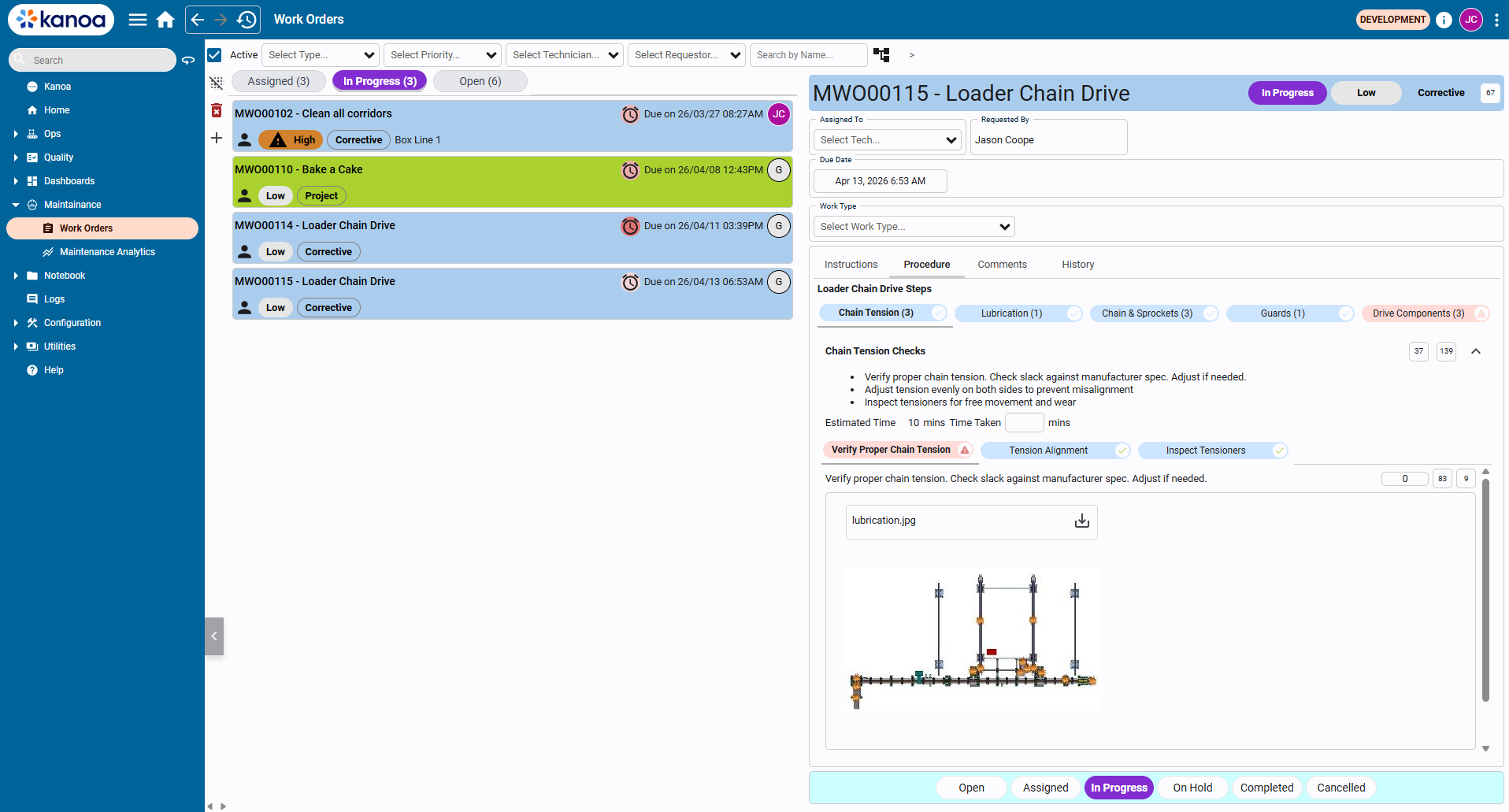
Kanoa Maintenance is an integrated maintenance management solution built directly into Kanoa MES, enabling teams to manage maintenance workflows alongside production, quality, and operational analytics.
Unlike traditional CMMS systems, Kanoa Maintenance operates natively within the Ignition + Kanoa MES environment, eliminating system fragmentation and allowing maintenance to be analyzed in the same context as production performance.

 is an add-on solution to KanoaOps
| In This Section | |
|---|---|
| Work Order Management | Work Order Management overview |
| Analytics | Built-in KPI's to provide a complete view of maintenance performance |
| Procedures | Define step-by-step instructions technicians follow when executing maintenance work |
| Creating Work Orders | Create one off work orders or reusable templates |
Work Order Management
- Create, assign, and track work orders
- Manage full lifecycle from creation to completion
- Capture technician actions and status changes
- Filter by asset, type, priority, and status
Work orders are the core unit of maintenance execution. Each work order moves through a lifecycle of 'Created', 'Acknowledged' / 'Assigned', 'In Progress', 'Completed' or 'Cancelled'. Work orders capture asset and location, maintenance type (preventive, corrective, etc.), priority, the assigned user, labor hours, parts used and timestamps for lifecycle events.
The system tracks all open work orders and provides insight into backlog health. Backlog aging shows how long work orders have been open to help identify stale or neglected work, capacity issues or prioritization problems.
Maintenance is performed against assets defined in the Kanoa MES asset model. This enables equipment level maintenance tracking, hierarchical rollups (line, area, plant) and integration with production and downtime data.