Condition-Based Maintenance
Some maintenance should follow how hard an asset works, not the calendar. A Condition template raises a work order when an asset's run hours or a counter reach a threshold, or when a tool's life comes due. Technicians respond as in Condition-Based Work.
Create a Run-Hours Template
For example, CoreForge's spindle service on Machine 1.
-
Open Configuration → Maintenance → Work Orders and add a template on the Work Orders tab.
-
Fill in the details:
Field Example Title Machine 1 - Spindle serviceAsset CoreForge\Philadelphia\Machining\Machine 1Maintenance type Preventive Work type Spindle ServicePriority Medium Schedule type Condition -
In the Condition section, choose
Run Hoursand enter the interval in hours. -
Set Last serviced on and Last value to say where the count starts.
-
Save the template and set its version status to Released.

Choose Counter instead to trigger on an asset counter, such as parts made.

Releasing a Condition template starts the checks straight away. Set Last serviced on and Last value correctly, or a work order may be raised before it is due.
Use Tool Life
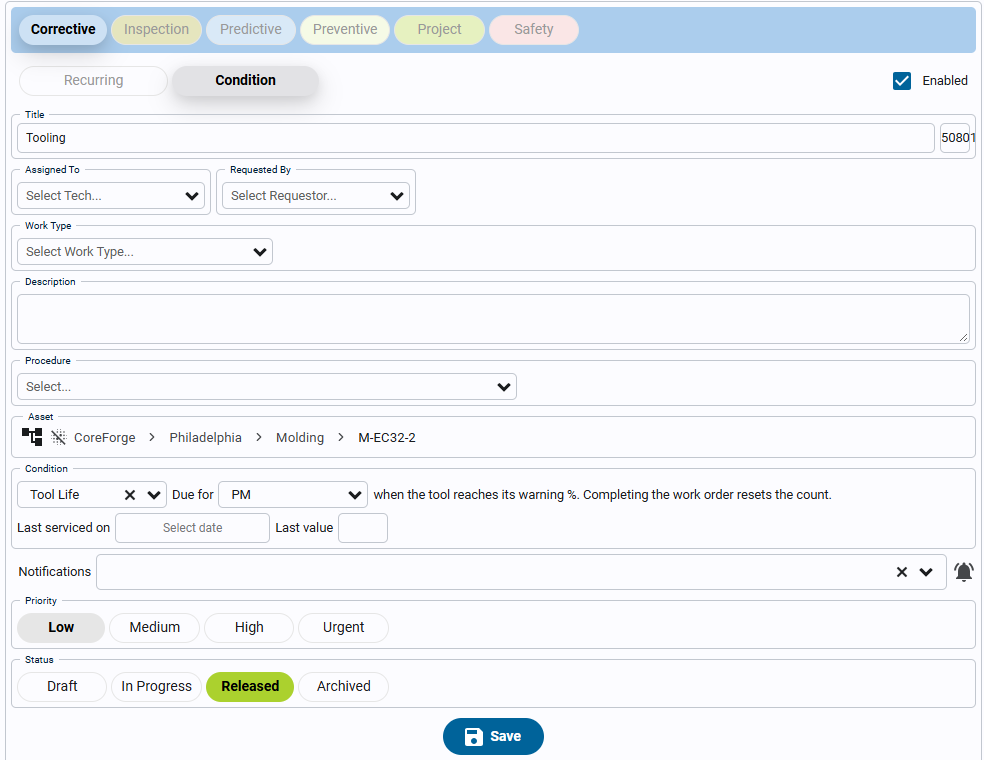
Tool Life is only offered when the template's Asset is a tool, such as a mold, so select the tool first.
- Set Asset to the tool.
- Choose Tool Life as the condition.
- Set Due for to the tool limit the work order covers: its PM, refurbishment or calibration.
A work order is created when the tool reaches its Warn at % of that limit. Completing the work order resets the count, the same as recording it on the tool's Life tab. The work orders for a tool are listed on the Maintenance tab of its tool editor.
Reference Materials: Schedule Types - One Time, Recurring and Condition.
Schedule Types
A Work Order template includes a Schedule Type, which determines how work orders are generated. When a template is active i.e. 'Released', the system evaluates its schedule configuration. When the criteria are satisfied, an actual work order is created.
Kanoa Maintenance supports three primary schedule behaviors:
Use One Time when the template should generate a single work order.
This is useful for:
- one-off repairs
- installation work
- project tasks
- ad hoc maintenance requests
When a template is configured as One Time, the system generates one actual work order from that template.
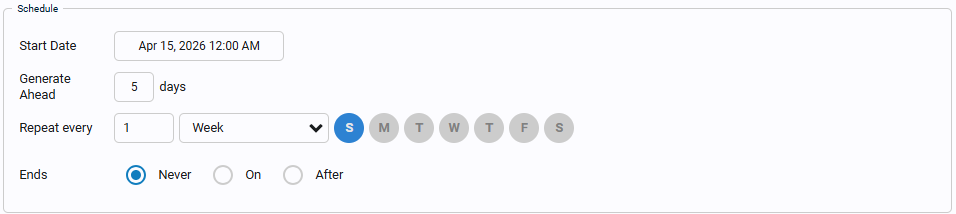
Use Recurring when the template should continuously generate work orders on a defined schedule.
This is typically used for:
- preventive maintenance
- routine inspections
- repeating safety checks
- calendar-based maintenance programs
When a template is configured as Recurring, the system creates actual work orders according to the recurrence settings. The schedule's times are in the asset's site time zone (UTC if the site has none), so a work order due at 06:00 stays at 06:00 at the plant across daylight-saving changes.
Recurring schedules are best used when maintenance should happen on a predictable interval, such as:
- every day
- every week
- every month
- every X days/hours depending on schedule configuration
Use Condition when the template should generate work orders only after a defined asset condition, counter, or threshold is met.
This is typically used for:
- runtime-based maintenance
- counter-based maintenance
- threshold-triggered inspections
- condition-based corrective or preventive work
When a template is configured as Condition, the maintenance order can be set to be triggered whenever the asset run hours or counter values reach a certain threshold, or, for a tool, when its tool life comes due. Condition scheduling is useful for maintenance strategies that should not be driven by calendar date alone.
Tool Life works with Kanoa Ops tooling. It's only offered when the template's Asset is a tool, such as a mold, so select the tool first. Set Due for to the tool limit the work order covers: its PM, refurbishment or calibration. A work order is created when the tool reaches its Warn at % of that limit, and completing the work order resets that count, the same as recording it on the tool's Life tab. The tool's work orders are listed on the Maintenance tab of its tool editor.
Worked Example
The CoreForge sample plant raises a spindle service on Machine 1 from its run hours, the same as Developer Training.
Check Your Understanding
- Name three conditions that can raise a work order.
- When is the Tool Life option offered?
- What does completing a tool-life work order do?
Answers
- Asset run hours, a counter value, or a tool's life reaching its Warn at %.
- Only when the template's Asset is a tool, such as a mold.
- It resets the tool's count for that limit, the same as recording it on the tool's Life tab.