Write a Procedure
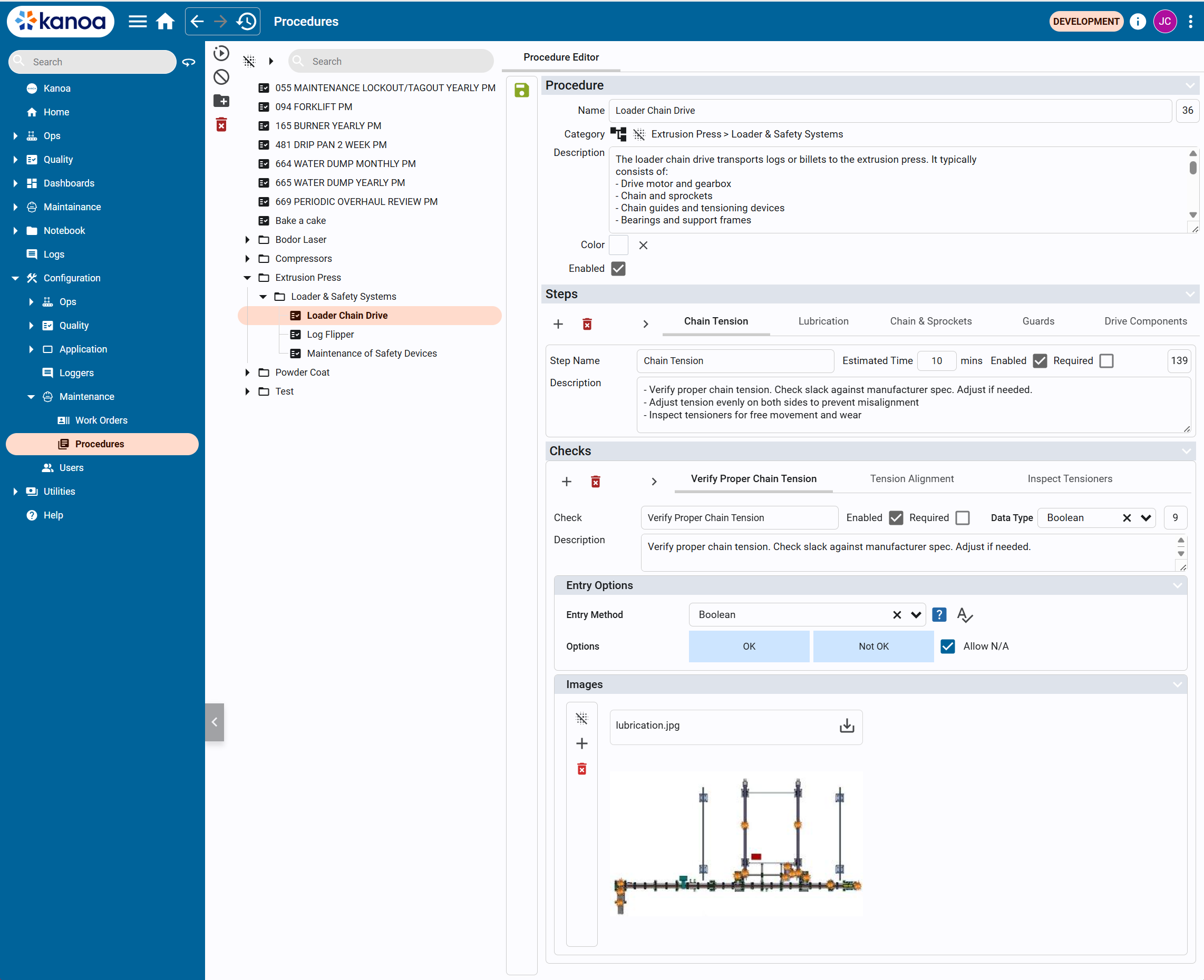
A procedure is the set of steps a technician follows. You write it once and attach it to a work order template. Every work order made from that template then carries the same instructions, and the results are recorded.
What a Procedure Contains
| Part | What it is |
|---|---|
| General Information | The name, category and description |
| Step | A major phase of the job, with an estimated time in minutes |
| Check | One task or verification inside a step |
| Entry options | How the technician records a check's result |
| Images | Diagrams or photos that show the technician what to look at |
Steps and checks each have Enabled and Required flags. A check also has a data type that decides how its result is captured.
Build the Procedure
For example, CoreForge's weekly PM for Machine 1 has three steps: Lubrication, Coolant System and Safety Guards.
- Open Configuration → Maintenance → Procedures.
- Create a category for your procedures, such as
Machining. - Add a procedure in it with a name, such as
Machine 1 Weekly PM, and a description. Make sure it is enabled. - Add each step with its name and estimated time, such as
Lubricationat 10 minutes. - Add the checks under each step, such as
Way lube reservoir filled. Choose each check's data type and entry options. - Save the procedure.
Attach an image to a check where the technician needs to know where to look, such as a lube fill point.
Attach It to Work
A procedure does nothing until you attach it to a work order template. You do that when you plan the work, in Plan Preventive Maintenance. Technicians then work through it as described in Execute a Work Order. The time they enter on each step is reported as procedure step hours.
Reference Materials: Procedures - Steps, checks and entry options.
Maintenance procedures define the step-by-step instructions technicians follow when executing maintenance work. Once a procedure has been defined, it can then be attached to a maintenance work order.
A procedure is composed of:
- General Information (name, category, description)
- Steps (high-level phases of work)
- Checks (detailed verification tasks within each step)
- Entry Options (how technicians record results)
- Images (visual references)
The general workflow is that:
- User defines a procedure
- Procedure is attached to a work order template
- Work orders are generated from the template
- Technicians execute the procedure step-by-step
- Results are recorded through checks
Steps
Steps represent the major phases of a procedure. Each step includes:
- Step Name (e.g., Chain Tension)
- Estimated Time (in minutes)
- Enabled / Required flags
- Description
Steps are typically sequential and guide the technician through the overall workflow.
Checks
Checks are detailed tasks or validations within each step.
They define exactly what the technician must verify or perform.
Each check includes:
- Check Name
- Description
- Enabled / Required flags
- Data Type (how results are captured)
- Entry Options define how the technician records the result of a check.
- Images can be attached to a check to provide visual guidance, reference diagrams and/or inspection points.
Worked Example
The CoreForge sample plant writes a weekly preventive maintenance procedure for Machine 1, the same as Developer Training.
Write a Procedure
A procedure is the step-by-step instructions a technician follows. You write it once and attach it to work order templates, so every work order generated from them carries the same instructions, and every result is recorded.
| Part | What it is |
|---|---|
| Step | A major phase of the job, with an estimated time |
| Check | One task or verification within a step, with a data type for recording the result |
| Entry options | How the technician records the result, such as OK / Not OK |
| Images | Diagrams or photos that show the technician what to look at |
-
Navigate to Configuration → Maintenance → Procedures and create a category
Machining. -
Add a procedure in it named
Machine 1 Weekly PM, with the descriptionWeekly preventive maintenance for the Machine 1 machining center., and make sure it's enabled. -
Add three steps, all enabled and required:
Step Estimated time Checks (all Boolean, entry method OK / Not OK) Lubrication10 mins Way lube reservoir filled,Spindle lube level OKCoolant System15 mins Coolant concentration in range,Coolant filter cleanSafety Guards5 mins Door interlock working,E-stop tested -
On the
E-stop testedcheck, clear Allow N/A, so the technician can't skip it. -
Save the procedure.
Attach an image to any check where the technician needs to know exactly where to look, such as the lube fill point. It shows on the work order next to the check.
Reference Materials: Procedures
Maintenance procedures define the step-by-step instructions technicians follow when executing maintenance work. Once a procedure has been defined, it can then be attached to a maintenance work order.
A procedure is composed of:
- General Information (name, category, description)
- Steps (high-level phases of work)
- Checks (detailed verification tasks within each step)
- Entry Options (how technicians record results)
- Images (visual references)
The general workflow is that:
- User defines a procedure
- Procedure is attached to a work order template
- Work orders are generated from the template
- Technicians execute the procedure step-by-step
- Results are recorded through checks
Steps
Steps represent the major phases of a procedure. Each step includes:
- Step Name (e.g., Chain Tension)
- Estimated Time (in minutes)
- Enabled / Required flags
- Description
Steps are typically sequential and guide the technician through the overall workflow.
Checks
Checks are detailed tasks or validations within each step.
They define exactly what the technician must verify or perform.
Each check includes:
- Check Name
- Description
- Enabled / Required flags
- Data Type (how results are captured)
- Entry Options define how the technician records the result of a check.
- Images can be attached to a check to provide visual guidance, reference diagrams and/or inspection points.
Check Your Understanding
- What is the difference between a step and a check?
- What decides how a technician records a check's result?
- How does a procedure reach a technician?
Answers
- A step is a major phase of the job. A check is one task or verification inside a step.
- The check's data type and its entry options.
- You attach it to a work order template. Work orders generated from the template carry the procedure.