Users and Roles
Kanoa decides what each person can do from their roles, and each role applies to the assets you pick. This lesson shows you how to add a user, give them a role on part of the plant, and remove them when they leave.
How Kanoa Security Works
Ignition checks who a user is when they sign in. Kanoa then decides what they can do, using three things:
- Roles hold security functions, such as Operate Assets or Configure Items.
- Users are given roles.
- Each role assignment applies to the assets you choose.
So a user can be an operator on Manual Pack 1 but have no rights on Machine 1, or have a role for a whole area or site.
The first user to sign in to a new Kanoa MES install is a Gateway Admin, who has every right on every asset. Only a Gateway Admin can make another user a Gateway Admin.
Roles: Built In and Custom
A role is a named set of security functions. Kanoa MES creates a role for each role in this course, each with a starting set of functions:
| Role | Functions it starts with |
|---|---|
| Administrator | Every function |
| Operator | Operate Assets, Edit Operations, Enter Checks, Enter Work Orders |
| Supervisor | Configure Security, Operate Assets, Edit Operations, Schedule Shifts, Schedule Operations, Enter Checks, Approve Checks, Enter Work Orders, Approve Work Orders |
| Operations Scheduler | Configure Assets, Configure Items, Operate Assets, Edit Operations, Schedule Shifts, Schedule Operations |
| Quality Inspector | Enter Checks |
| Quality Manager | Configure Quality, Enter Checks, Approve Checks |
| Maintenance Technician | Enter Work Orders |
| Maintenance Manager | Configure Maintenance, Configure Procedures, Configure WorkOrders, Enter Work Orders, Approve Work Orders |
Check that each role's functions suit your plant before you give it to anyone. Kanoa only adds a role, or its starting functions, when it's missing, so a role your gateway already had keeps the functions it had. You can also create your own roles, such as a process engineer, with just the functions that job needs.
- Open Configuration → Users, and go to the Roles tab.
- To make a new role, create it and enter its Role Name.
- Tick the functions the role needs. Each function is a checkbox column, and a change is saved as soon as you tick or clear a box. The Functions tab describes what each function allows.
Changing a role's functions changes them for every user who has that role, on every asset they have it for.
Anyone can view the Roles tab. Changing it needs Configure Security, the same as adding users.
To let a manager add the people on their team, such as a Maintenance Manager adding technicians, add Configure Security to their role and give them that role only on their own area. Configure Security also lets them give any role and change roles' functions, so think before you add it. The Maintenance Manager track's Set Up for Maintenance lesson shows the trade-off.
Add a User
Adding, editing and deleting users needs the Configure Security security function.
- Open Configuration → Users, and go to the Users tab.
- Click the + button.
- Enter the user's first name and last name. Both are required.
- Save the user.
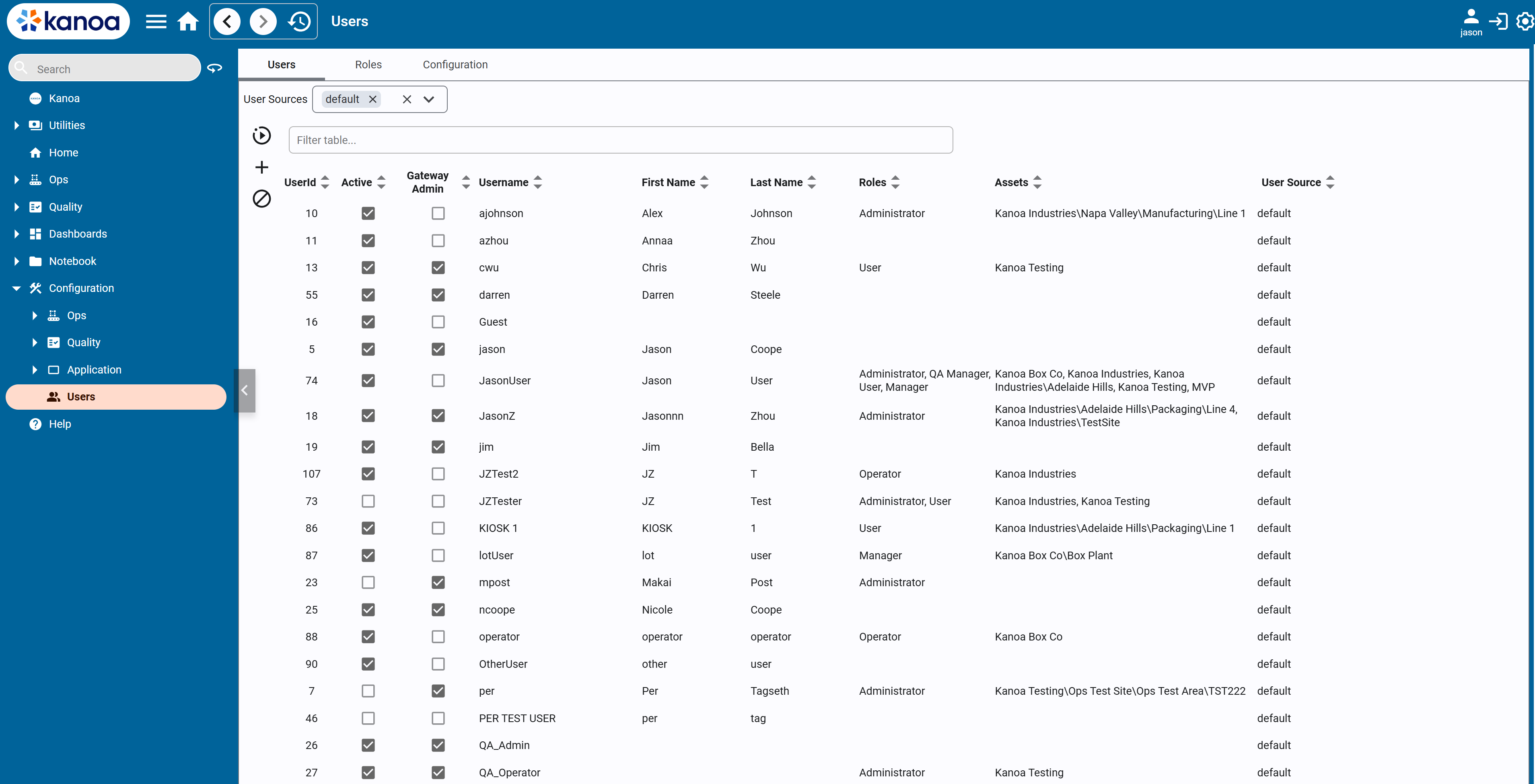
Creating a user here works for the gateway's default (internal) user source. For Active Directory or an identity provider, the account is managed outside Kanoa and you only set its roles.
Give a User a Role on Their Assets
- On the Users tab, select the user and click the edit button, or double-click the user.
- Open the Roles tab.
- Select the role, such as Operator.
- Click the asset selector, and choose the assets the role applies to.
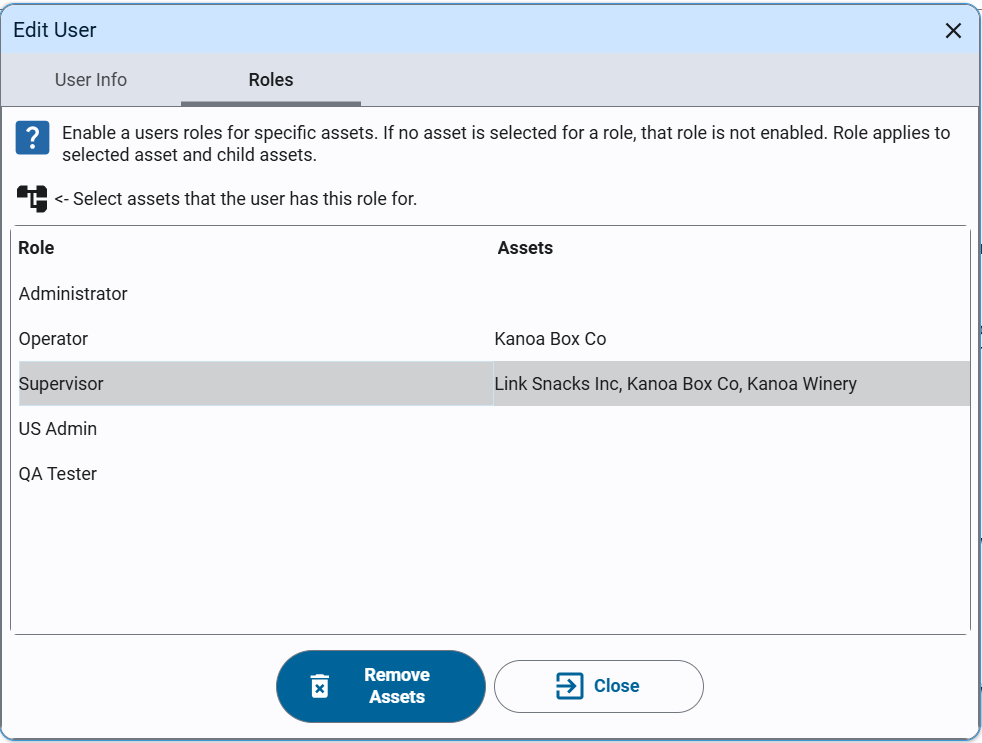
For example, give Operator on the Finishing area to someone who runs Manual Pack 1. They can operate every asset in that area, and nothing in Machining or Coating.
To take a role away, select it and click Remove assets.
Anyone with Configure Security can edit the Roles tab, where you choose which functions each role has. Changing a role changes it for every user who has it. Only a Gateway Admin can make another user a Gateway Admin.
Remove a User Who Has Left
- On the Users tab, select the person.
- Delete the user.
Kanoa deletes the user in the default user source and deletes their Kanoa record. For a user from Active Directory or an identity provider, Kanoa only deletes its own record, and you must remove the account at its source.
Deleting a user can't be undone, and the person can no longer sign in. If someone might return, remove their roles instead, as shown above.
Reference Materials: User Configuration - Create, edit and delete users, and set their roles per asset.
User Configuration
When the ignition user source is set to internal, users can be added and deleted via the User table. If the userSource is set to Active Directory, only a user's roles can be configured.
The User Sources drop down can be used to filter users by the user source.
The 'active' field is set the first time a user logs into the MES application.
Creating and Editing Users
Click the + button to add a new user or select a user and click the  button.
A first and last name is required for a user. This allows us to filter out users that may have been setup for kiosk auto-login or Active Directory printers etc.
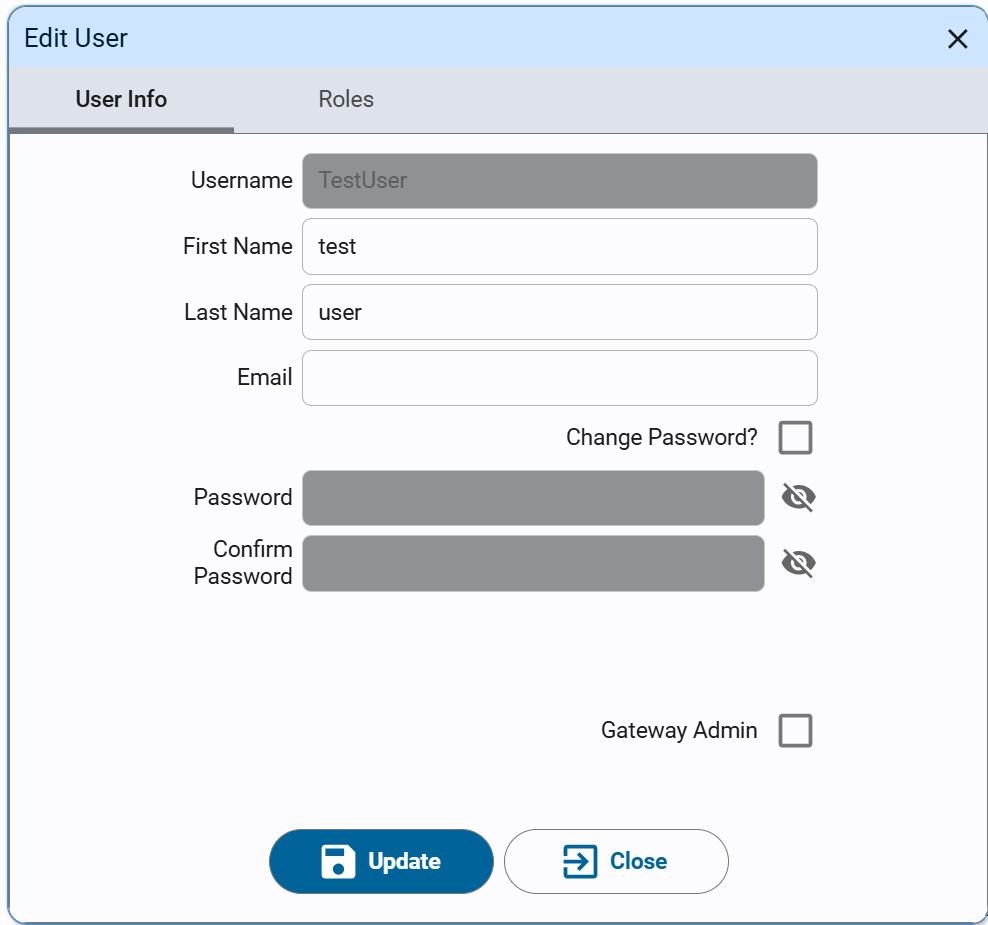
A user can be assigned a role along with a list of assets where that role is valid. This allows you to set a user to be an operator at say the mill, but not at the packaging line.
A user can given Gateway Admin permissions by enabling the Gateway Admin checkbox. There is no need to set specific roles to specific assets for a Gateway Admin as they automatically inherit all rights over all assets.
The first user to log into a freshly installed KanoaMES application will automatically be granted Gateway Admin rights. Only Gateway Admins can give Gateway Admin rights to other users.
To add a role to a user, select the role you wish to assign to the user and then click on the  to select the assets.
To remove a user's roles, select the role you wish to remove from the user and then click the 'Remove assets' button.
Check Your Understanding
- Which security function lets you add and delete users?
- A new operator should run only Manual Pack 1. How do you limit their role to it?
- A user comes from Active Directory and has left. What does deleting them in Kanoa do?
Answers
- Configure Security.
- Give them the role, then select only Manual Pack 1 (or its area) with the asset selector.
- It deletes Kanoa's record of the user only. You must also remove the account in Active Directory.